Vamana and the Three Steps of Bankruptcy
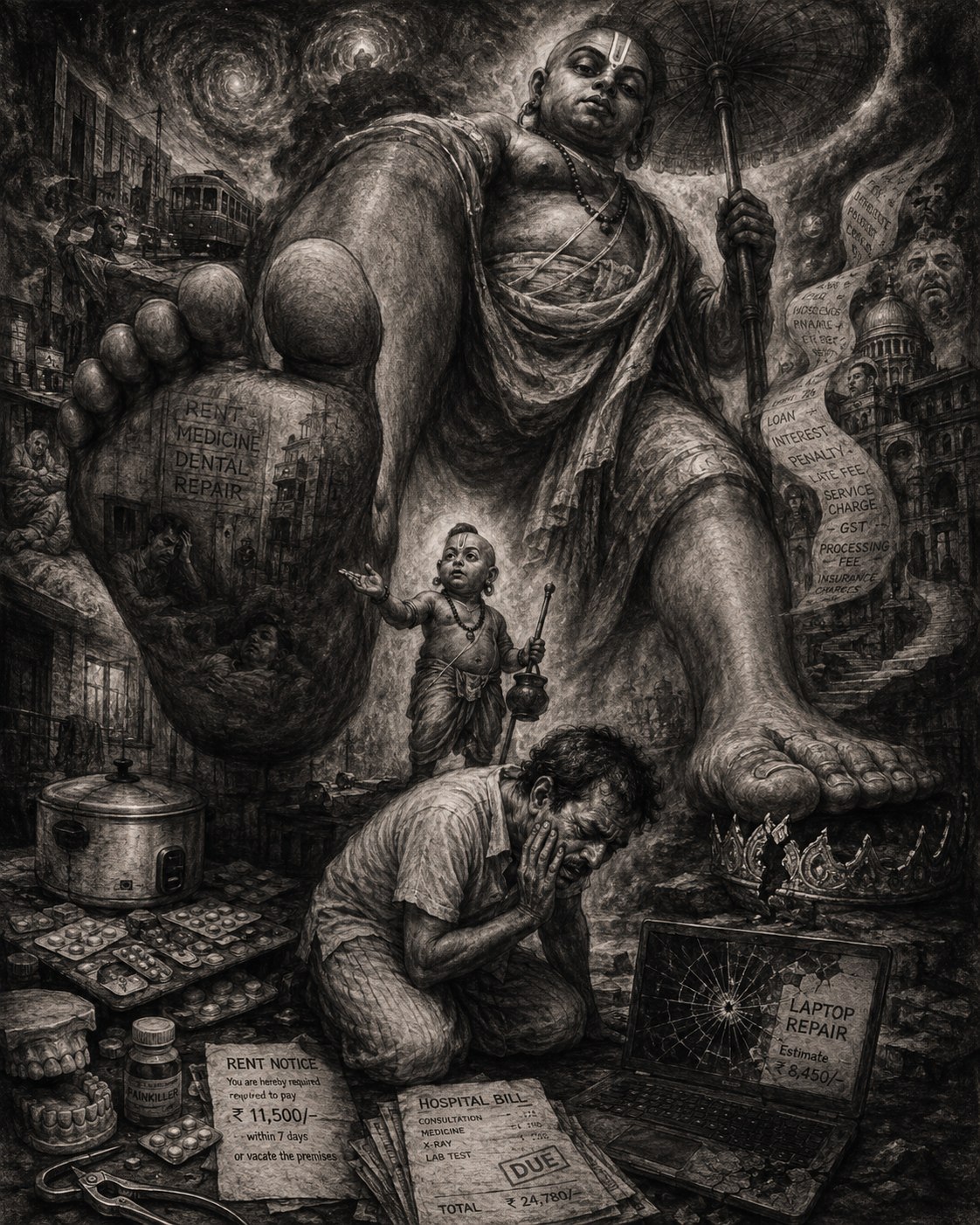
Bankruptcy does not knock like a villain. It does not arrive wearing black robes, twirling a moustache, and announcing, “Prepare to surrender your dignity by Thursday.” It comes as a small thing. A polite thing. A dwarf thing.
Rent.
Medicine.
A tooth.
A laptop hinge.
A ceiling fan making a sound like a tired tram dragging its feet through Esplanade.
That is the trick. Disaster in middle-class life rarely begins as disaster. It begins as an amount so small that even complaining about it feels shameful. You look at the number and think, this should not frighten a grown man. This should not make a 51-year-old Bengali with a computer science degree, a US education, and fifteen years of work behind him sit on the edge of a mattress in South Calcutta staring at the wall like a lizard awaiting government orders.
But it does.
The old story says Vamana, the dwarf incarnation of Vishnu, went to King Bali and asked for only three steps of land. Very modest. Very sweet. Almost suspiciously reasonable, which is how all dangerous requests begin. Bali, being generous and powerful and therefore temporarily stupid, agreed. Then Vamana began to grow. One step covered the earth. One step covered the heavens. There was nowhere left for the third. So Bali offered his own head.
This is not only mythology. This is household finance.
One small expense asks for three steps. Then it expands and covers everything.
The first step covers the body.
A toothache is not a toothache when you are financially safe. It is a nuisance, a dental appointment, a mildly boring afternoon in a chair while a dentist says things like “open wider” with the calm cruelty of a customs officer inspecting contraband. You pay. You leave. You complain about the bill over coffee.
A toothache when money is short is a referendum.
Can it wait? Can it be managed with painkillers? Is the swelling serious? Will extraction be cheaper? What if the dentist says implant? What if implant becomes a number so large it deserves its own PIN code? What if infection spreads? What if the pain arrives at night, when the city is asleep except for dogs, mosquitoes, and men like me lying awake with jaw pain and philosophical resentment?
Then the tooth grows.
It is no longer one molar. It is transport. It is consultation. It is medicine. It is courage. It is shame. It is the small yellow light of the pharmacy. It is the sound of UPI after payment, that cheerful little confirmation noise that says, congratulations, another tiny piece of your future has just left the building.
You think the body is private. Poverty disagrees.
The second step covers the mind.
Money fear is not worry. Worry is what respectable people do while drinking tea. Money fear is a monkey with a calculator sitting inside your skull. It does not sleep. It does not blink. It keeps adding.
Rent plus medicine.
Medicine plus food.
Food plus electricity.
Electricity plus internet.
Internet plus the laptop repair without which the consulting work cannot happen, and without the consulting work the laptop repair becomes a joke told by Satan to other accountants.
Then the mind starts doing that horrible thing poor and precarious people know too well. It begins pre-spending money that has not arrived. It begins negotiating with bills in imagination. It begins moving dates around like furniture in a room too small for furniture. Pay rent first. No, medicine first. No, laptop first, because work. No, food first, because the stomach is not impressed by strategy documents.
The mind becomes a railway platform announcement at Sealdah. Everything is delayed. Everything is urgent. Everything is slightly unclear.
Meanwhile, outside the window, ordinary Calcutta continues its grand opera of survival. Someone is selling muri. Someone is arguing over ten rupees. A bike is honking as if the British are still here and need to be expelled by sound. A delivery boy is climbing stairs in the heat with food he probably cannot afford to order. The city goes on. It always goes on. Calcutta could be hit by an asteroid and within forty minutes someone would set up a tea stall beside the crater.
Inside the room, however, the mind is not going on. It is shrinking.
This is the part people with steady salaries rarely understand. One small unpaid bill does not remain in one corner. It spreads. It sits on your book. It sits on your pillow. It sits between you and the sentence you are trying to write. It enters the tea. It opens the fridge and laughs. It turns the laptop into a sick relative and the phone into a priest of bad news.
I have lived with bipolar depression and anxiety long enough to know the difference between sadness and siege. Sadness has weather. Siege has logistics. When money fear enters the room, it brings files, dates, reminders, threats, and a face like an LIC agent who has discovered your fraud against optimism.
The third step covers dignity.
This is the worst one.
The body can hurt. The mind can race. But dignity is the floor. Once that cracks, you do not merely suffer. You become visible in the wrong way.
You become the man explaining.
Explaining why payment is late. Explaining why work is delayed. Explaining why the tooth has not been fixed. Explaining why the laptop is not working. Explaining why, despite education and English and foreign degrees and all the decorative certificates society loves to worship, you are still standing in the queue of ordinary panic like everyone else.
There is a special humiliation reserved for the educated lower-middle-class Bengali. He is not poor enough to receive clean sympathy. He is not rich enough to be safe. He lives in the corridor between pity and contempt. People see the books, the English, the past US life, the old professional vocabulary, and assume there must be a hidden locker somewhere. Surely such a man cannot be struggling with rent and medicine. Surely this is mismanagement. Surely he should have planned better, invested better, networked better, smiled better, pivoted better, married better, meditated better, eaten chia seeds, joined LinkedIn earlier, and become a consultant with a blue blazer and the dead eyes of a hotel conference speaker.
This is how society protects itself.
It turns your suffering into your fault.
Of course, some of it is your fault. Let us not become saints just because the electricity bill arrived. I have made mistakes. Some through illness. Some through fear. Some through stubbornness. Some through the magnificent Bengali talent for seeing a hole in the road and then stepping into it while analyzing municipal failure.
But a life is not a neat school arithmetic problem. It is not bad choices in, bad outcome out. It is more like cooking rice during loadshedding. You may have rice, water, a cooker, and intention. Then the power goes. Then the cat knocks something over. Then the phone rings. Then the gas cylinder is low. Then the neighbor begins drilling into the wall because civilization has apparently failed to discover silence.
A life has timing. Illness. Luck. Class. Family. Country. Temperament. Markets. Teeth. Heat. Rent. Depression. Bad years. Worse months. And sometimes one little expense arrives at exactly the wrong moment, like a mosquito entering the ear just when you have decided to be a philosopher.
The non-poor love to talk about discipline. Discipline is useful. But without buffer, discipline becomes a man trying to stop a flood with an old Gamchha.
Buffer is the real middle-class god, though I say this as an atheist with no desire to add more gods to an already crowded subcontinent.
Buffer means a few months of rent.
Buffer means the tooth can be fixed before it becomes a courtroom drama inside the jaw.
Buffer means the laptop can be repaired before livelihood falls into the drain.
Buffer means medicine can be bought without standing at the counter conducting a parliamentary debate between health and groceries.
Buffer means a small problem remains small.
Without buffer, every dwarf becomes cosmic.
That is the secret of Vamana. The terror is not that he is large. The terror is that he begins small. If bankruptcy arrived as a giant, one could at least scream properly. But it arrives as ₹800 here, ₹2,500 there, ₹9,000 next week, ₹18,000 if the dentist frowns, ₹35,000 if the laptop motherboard develops royal ambitions.
Each figure says, I am only one step.
Then it grows.
In the morning you wake up and think, today I will work. This is a noble thought, and like many noble thoughts in India it immediately meets infrastructure. The internet flickers. The fan groans. The tea tastes faintly of defeat. Outside, a hawker is shouting with the lung capacity of a revolutionary. Somewhere a child is learning multiplication. Somewhere a minister is inaugurating something that will be dug up again in six months. Somewhere a billionaire is explaining innovation. Somewhere I am trying to decide whether the pain in my tooth is medical, financial, or cosmic.
It is all three, naturally. Life likes package deals.
Still, one must be careful. There is a cheap romance about suffering, and I distrust it. Poverty does not make people noble. Depression does not make people deep. Bankruptcy does not turn a man into a poet. Sometimes it turns him into a bore, a liar, a coward, a beggar, a philosopher, and a household appliance repair estimator, all before lunch.
But it does reveal scale.
It shows you how much of dignity depends on small hidden structures. Working teeth. Working devices. Working sleep. Rent paid. Food present. Medicines available. A little privacy. A little time. A little cash not already promised to someone else. Remove these, and the grand personality collapses like a pandal after rain.
People say, “Think big.”
My friend, I am trying to think small.
Very small.
Can I keep the room functioning? Can I keep the laptop alive? Can I keep medicine in reach? Can I keep rice and dal in the house? Can I keep one paying client from vanishing into the fog like a government file? Can I keep my temper from becoming a public event? Can I keep shame from becoming the landlord of my head?
This is not ambition. This is civil engineering.
The clean solution would be money. Let us not put incense sticks around economics and call it spirituality. Many things marketed as mindset problems are actually liquidity problems in a cheap kurta. Pay a man’s rent for six months and observe how quickly his “negative thinking” improves. Fix his tooth and see how his personality blossoms. Repair his laptop and watch motivation return wearing sandals.
But money may not arrive neatly. It may come late. It may come in drops. It may come with conditions, explanations, apologies, and the faint smell of humiliation. So the real question becomes less heroic and more useful.
What is the minimum dignity one can defend?
Not luxury. Not success. Not a TED Talk. Just minimum dignity.
For me, perhaps it is this: keep the rent alive, keep the medicines reachable, keep the laptop functioning, keep the phone charged, keep one path to work open, keep books nearby, keep the rice cooker clean, keep the room from becoming a museum of surrender, and keep telling the truth in sentences clear enough that even shame has to sit down and listen.
That may sound small.
Good.
Small is where the battle is.
Vamana asked for three steps. Bankruptcy does the same. The first step takes the body. The second takes the mind. The third waits for the head.
And yet Bali is not remembered as garbage. He is remembered as Bali. Overmeasured, yes. Defeated, yes. But not erased. There is a difference, and in hard months that difference is not decorative. It is oxygen.
A man can be under the third step and still not be only the footprint.
He can be tired, frightened, broke, ridiculous, irritable, ashamed, overeducated, underpaid, badly shaved, sitting in a rented room in the boondocks of Calcutta while the fan makes its circular argument overhead.
He can still be the witness.
He can still say: this bill is large, but it is not the whole universe.
Even when it behaves as if it is.